
Being Duty Manager
What it takes and why it can be the best job in the world

I’ve recently been writing some Duty Manager training at work, and it’s made me reflect on what I consider to one of the best roles in our sector.
The phrase ‘Duty Manager’ can mean different things in different places, so before I wax lyrical, let’s do a couple of definitions.
Collins English Dictionary defines a Duty Manager as a “person who is in charge at a particular time”, however the way this role operates can vary wildly across different organisations, even within the museum and heritage world. Some organisations split responsibilities. Some organisations may have a specific, designated role where someone is Duty Manager all the time. My preference, though, is to have the role rotate amongst a variety of operational managers, so that everyone involved in delivering the visitor experience gets a chance to sit in the hot seat.
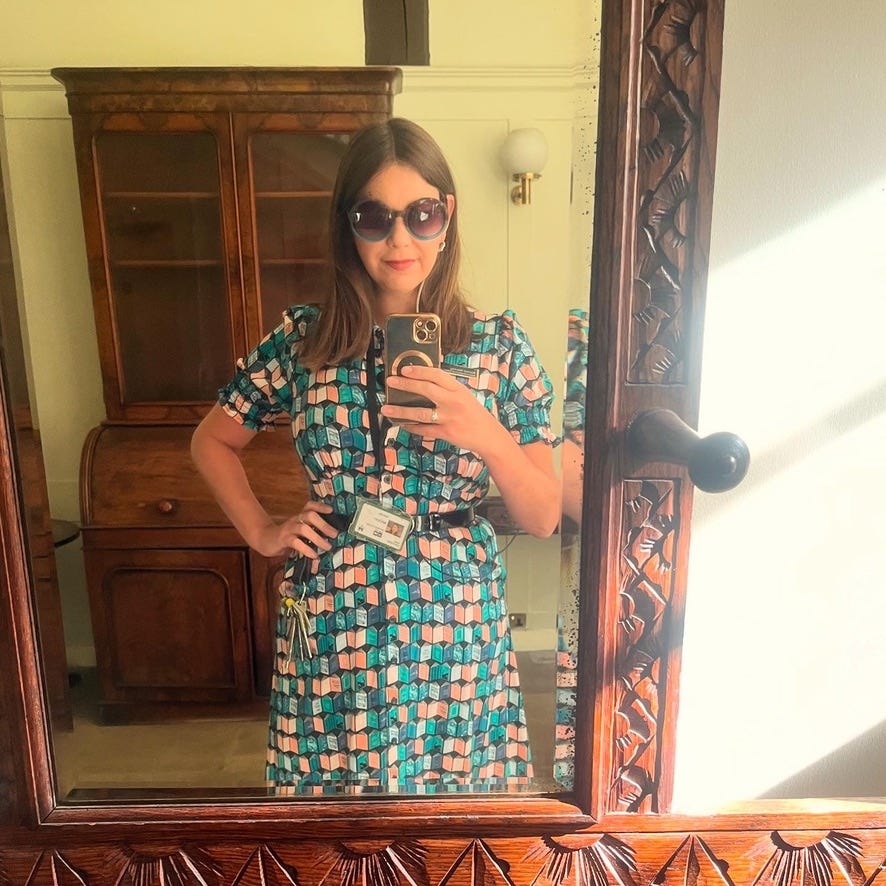
Ready for a summer DM shift at Hampton Court. Photo Credit: Rachel Mackay
Duty Managers may carry out a litany of tasks, from opening and closing the site, cashing up, dealing with visitor complaints, managing front facing teams and leading in the case of incidents and emergencies.
But for me, the most uniquely defining feature of the Duty Management role is its variety.
Last year, I posted the below to LinkedIn, bemoaning the sheer amount of stuff you have to carry around with you as a Duty Manager – at last count, it was 3 phones, 2 sets of keys and a radio. It seemed to resonate, with DMs across the sector feeling the pain – particularly amongst women, where the long fight for pocket equality rages on.
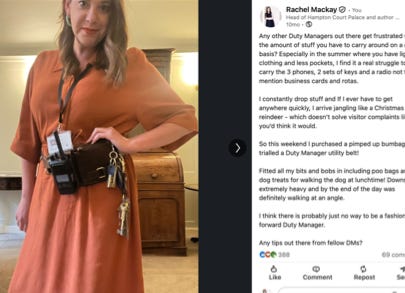
Photo Credit: Rachel Mackay/LinkedIn
Some got in touch to suggest ways of slimming down my accoutrements – call forwarding etc., suggesting a level of confidence in my tech skills that simply isn’t there. But the stuff we carry around as DM is emblematic not only of the weight of responsibility, but also the sheer breadth of scope. As DM, you are responsible for the whole gamut of the visitor journey, even if it’s not something you usually look after as part of your day job. This means the variety of stuff you might be called on to deal with can be overwhelming. Like most people, I have my share of WTF stories from a career of being a Duty Manager.
Every DM has had various animal related nightmares, and I’m no exception having met with everything from injured birds and angry swans to lost dogs and marauding deer. But my favourite one was from a previous role where sheep routinely escaped and a common pastime for DMs was wrangling them back into their enclosure. I remember one day being in the Control Room, and the CCTV alerted us to the fact that the sheep were escaping. We had fancy motion activated CCTV at the time, and the image of the CCTV zooming in, Spooks-style (there will be a more up to date reference, but God, Spooks was great) on the face of a determined ewe in full flight was extremely satisfying.
Weather is always a rich seam to mine for good DM stories. I remember one day at Hampton Court, the Great Fountain was barriered off for maintenance, but a storm the previous day had blown all of the barriers into the pond. I was pulling them out one by one (the glamour of Palace life) when I intrepidly but ill-advisably suggested to a passing Security Officer that he hold my ankles so I could pull the rest in. He wisely refused, grumbling “I don’t want to see tomorrow’s washing.”
Of course, there are more visitor behaviour stories than I can write about without losing all faith in humanity, from queue rage to protests and even counter-protests. But by far the issue I dread most as DM is anything to do with toilets. You know it’s a bad day in the office when you have to create the below WhatsApp group.
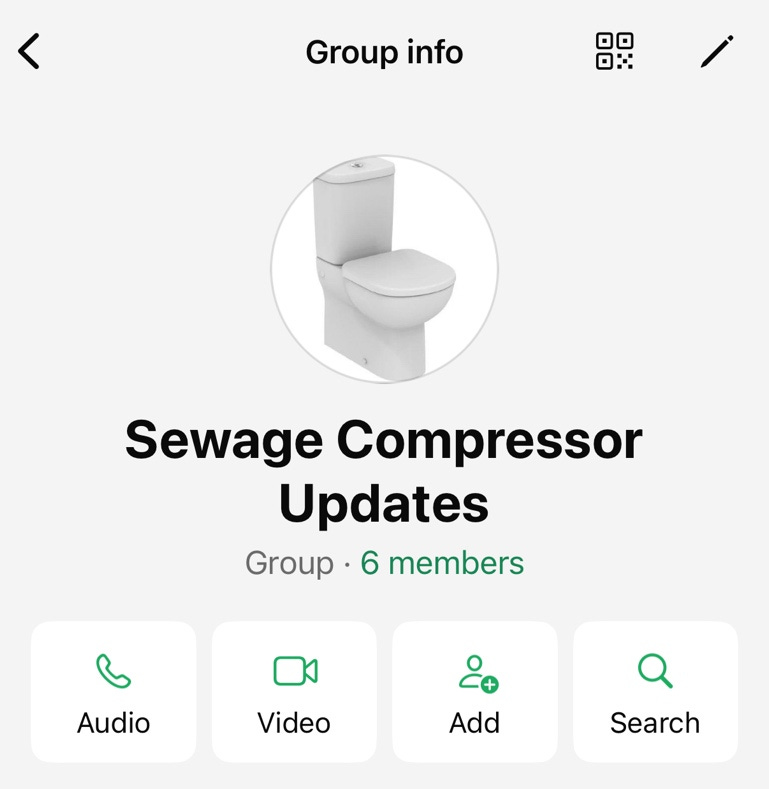
The group no DM wants on their phone. Photo Credit: Rachel Mackay
So, with the DM role requiring you to be an animal handler, a plumber and everything in between, how on earth do we train new Duty Managers? This is the conundrum I faced recently when I realised we don’t really have any set DM training – nor could I find any online. In fact, when I thought back, I realised I have never really had any DM training in any of my previous organisation. Yes, there a has been the odd course in regards to crisis management or the various Government issued counter-terrorism modules. There have been bits and pieces from other training that have related to DM work – performance management, health and safety, visitor engagement standards. But learning how to be a DM in itself mainly seems to happen on the job.
This isn’t necessarily a bad thing. On the job shadowing is a great way to learn the ropes of a job that is primarily reactive and practical. You can glean so much from how your colleagues handle different situations, and how they talk about previous incidents – everyone has their own back catalogue of WTFs. However, with no set training and no standardised principles of Duty Management, how can we ensure this role that is so pivotal in delivering the visitor experience is consistently applied, especially in an organisation like ours that stretches over multiple sites?
We are very lucky in Historic Royal Palaces to have an online resource called the Visitor Experience Academy where staff across all Palaces can dip in to consistent VEX content from wherever they are. Now, I’m in the process of adding some DM modules to the VEX Academy, and it’s got me thinking about what non-site specific content to include.
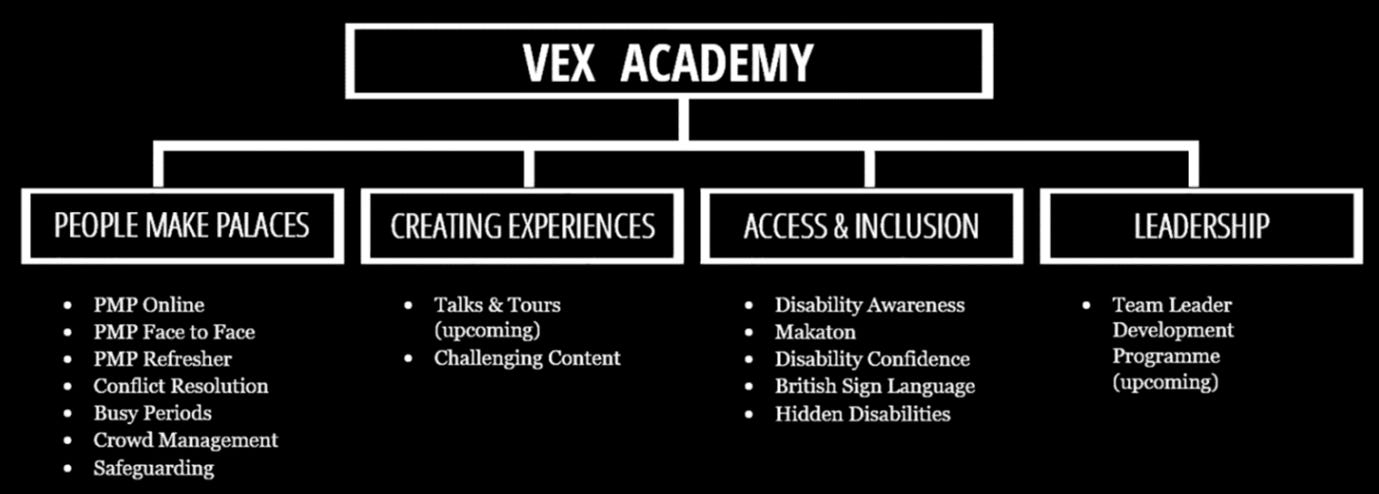
A snapshot of our Visitor Experience Academy. Credit: HRP
I definitely think there’s a mindset piece about how you approach the role of DM. I always find I enjoy it most, and am better at it, if I can face the day with no other obligations. Trying to cut down on other meetings and commitments as much as possible, so that you can devote yourself to being both proactive and reactive is really important. Realistically, it’s not always possible. But if I am able to give myself the freedom to just be Duty Manager, I open up my capacity to deal with the unexpected and to be more intentional about ensuring my site is delivering the best visitor experience it can.
There’s another philosophical shift you have to make when you’re DM, and that’s going from worrying about the little slice of the business that you are personally responsible for to thinking about the whole pie of the visitor journey. This is something new DMs can struggle with, as the temptation can be to stay in your comfort zone. But as Visitor Experience professionals, it’s a really important mindset to get, and doing DM shifts can be great for building the habit.
As well as the DM mindset, there are definitely skills we can train and develop that come into play in the Duty Management role. Although much of our crisis management plans might deal with site specifics, there is also a general piece around leadership in a crisis, including decision making under pressure, influencing skills, coordination and prioritisation – this is all stuff it’s better to learn about before something goes wrong rather than after.
Conflict resolution is another area that is important to develop for the DM role. I’ve written elsewhere about how visitor conflict has reportedly increased since the pandemic, and the role of DM as peacemaker is more important now than ever. Some understanding and experience of de-escalating issues is therefore, another really important aspect.
So, there’s a little taste of what I think will be covered in our new DM modules. I’m hoping that a bit more emphasis on training and development will really highlight how important this role is in the visitor experience, and how much scope there is within it to learn new things and push yourself out of your comfort zone.
As should be obvious by now, I love being DM. That hasn’t always been the case, and I’m well aware that these days I am writing from the privilege of not doing it now as often as I once did. It’s also a tiring job. In earlier, sprightlier years, I would have thought nothing of heading from a DM shift onto a night out and then back in the next day. These days, if I’m Duty Manager, there’s nothing going afterwards beyond a takeaway and cheering on the Gladiators. Still, when many areas of your work seem to be long term projects with the pay off more obscure and further away than ever, there is something to be said for the instant gratification of simply delivering a day well managed.
It’s really the best thing we can do for our visitors. And that is pretty special.